Comparing Datadog and Pingdom is like comparing a Swiss Army knife to a screwdriver. Both can drive a screw, but one does a hundred other things you may or may not need.
Datadog is a full-stack observability platform with 20+ products: infrastructure monitoring, APM, logs, synthetic monitoring, security, and AI observability. Synthetic monitoring, which handles uptime checks, is just one small piece. Pingdom is a focused website monitoring tool that does uptime checks, transaction monitoring, page speed analysis, and Real User Monitoring (RUM). That is the entire product.
The real question is not which tool is better. It is whether you need a full observability platform or just uptime monitoring. This article breaks down the pricing, features, and trade-offs so you can decide.
Quick Verdict
Choose Datadog if:
- + You already use Datadog for infrastructure or APM
- + You need synthetic tests correlated with traces and logs
- + You have a large engineering org with 100+ services
- + You need private testing locations (behind firewalls)
- − Budget predictability is not a concern
Choose Pingdom if:
- + You just need uptime and page speed monitoring
- + You want transaction monitoring in a real browser
- + You want Real User Monitoring (RUM) data
- + You want predictable, flat-rate billing
- − You do not need a free plan (Pingdom has none)
Two Very Different Tools
| Datadog | Pingdom | |
|---|---|---|
| Type | Full-stack observability platform | Focused website monitoring tool |
| Founded | 2010 (public company, NASDAQ: DDOG) | 2005 (now under Turn/River Capital via SolarWinds) |
| Products | 20+ (infra, APM, logs, synthetic, RUM, security, AI) | 4 (uptime, transaction, page speed, RUM) |
| Pricing model | Usage-based (per host, per test run, per GB) | Tiered flat-rate (22 tiers by monitor count) |
| Integrations | 1,000+ | ~15 |
| Free plan | Limited (5 hosts, 1-day retention) | None (14-day trial only) |
Note on Pingdom's ownership: SolarWinds was acquired by Turn/River Capital (a private equity firm) in April 2025 for $4.4 billion. SolarWinds was taken private and delisted from the NYSE. Private equity ownership of software products historically focuses on cost optimization rather than product innovation. Pingdom has not seen major feature updates in several years.
Pricing: The Real Costs
This is where the comparison gets interesting. Datadog's usage-based pricing makes it nearly impossible to predict costs without a calculator and a spreadsheet. Pingdom's tiered pricing is straightforward but not cheap.
Pingdom Pricing
| Monitors | Annual | Monthly | SMS Credits |
|---|---|---|---|
| 10 | $10/mo | $15/mo | 50 |
| 25 | $25/mo | $33/mo | 100 |
| 50 | $50/mo | $65/mo | 200 |
| 100 | $95/mo | $124/mo | 350 |
| 200 | $185/mo | $241/mo | 400 |
Pingdom has 22 pricing tiers total, scaling up to 30,000 monitors. All tiers include 1 minute check intervals. RUM costs extra, starting at $10/month for 100K pageviews.
Datadog Synthetic Monitoring Pricing
| Test Type | Annual | Monthly | On-Demand |
|---|---|---|---|
| API tests | $5 / 10K runs | $6 / 10K runs | $7.20 / 10K runs |
| Browser tests | $12 / 1K runs | $15 / 1K runs | $18 / 1K runs |
| Mobile app tests | $50 / 100 runs | N/A | N/A |
What 10 Uptime Monitors Actually Cost
Here is the math that most comparison articles skip. Let us say you want to monitor 10 URLs with 1 minute checks:
Datadog: 10 API tests at 1-minute intervals
10 endpoints × 1 test/minute × 60 minutes × 24 hours × 30 days = 432,000 test runs per month
432,000 runs ÷ 10,000 × $5 = ~$216/month (annual pricing)
This is for API tests only (HTTP checks). Browser tests would cost significantly more.
Pingdom: 10 monitors
$10/month (annual pricing). Flat rate. No math required.
For basic uptime monitoring, Datadog Synthetic Monitoring costs over 20 times more than Pingdom. This is the core of the comparison: Datadog's per-run pricing is designed for teams that already pay for Datadog's infrastructure monitoring and want synthetic tests as an add-on. If synthetic monitoring is your primary need, Datadog's pricing model works against you.
| Scenario | Datadog | Pingdom |
|---|---|---|
| 10 uptime monitors (1 min) | ~$216/mo | $10/mo |
| 50 uptime monitors (1 min) | ~$1,080/mo | $50/mo |
| 100 uptime monitors (1 min) | ~$2,160/mo | $95/mo |
Datadog estimates assume API tests at $5/10K runs (annual). Actual costs depend on check frequency and test type.
Feature Comparison
| Feature | Datadog | Pingdom |
|---|---|---|
| HTTP/HTTPS uptime checks | Yes | Yes |
| SSL certificate monitoring | Yes | Yes |
| DNS monitoring | Yes | No |
| TCP/UDP/ICMP checks | Yes | No |
| Transaction monitoring | Yes (Playwright) | Yes (real Chrome browser) |
| Real User Monitoring | Yes (separate pricing) | Yes (separate pricing) |
| Page speed monitoring | Via browser tests | Yes (dedicated feature) |
| Infrastructure monitoring | Yes ($15+/host/mo) | No |
| APM / Tracing | Yes ($31+/host/mo) | No |
| Log management | Yes ($0.10/GB+) | No |
| Private testing locations | Yes | No |
| Global probe locations | ~25 to 29 | 100+ |
Datadog has vastly more capabilities, but most of them are unrelated to uptime monitoring. If you need infrastructure monitoring, APM, and logs alongside your uptime checks, Datadog consolidates everything in one platform. If you just need to know whether your website is up, those extra products add cost and complexity without adding value.
One area where Pingdom has an advantage: 100+ global probe locations versus Datadog's ~25 to 29. More locations means better geographic coverage and fewer false positives from regional network issues.
Alerts and Status Pages
Alert Channels
| Channel | Datadog | Pingdom |
|---|---|---|
| Yes | Yes | |
| SMS | No native (via PagerDuty/OpsGenie) | Credit-based (capped per tier) |
| Phone calls | No native (via integrations) | No |
| Slack | Yes | Yes |
| Webhooks | Yes | Yes |
| PagerDuty / OpsGenie | Yes | Yes |
Neither tool excels at direct alerting. Datadog has no native SMS or phone call alerts. You need to integrate with PagerDuty or OpsGenie for voice/SMS escalation, which means an additional tool and additional cost. Pingdom includes SMS credits per tier (50 to 400 depending on plan) but has no phone call alerts.
Status Pages
Datadog offers status pages as part of its Incident Response suite. They support custom domains and public or private visibility. However, Incident Management and On-Call are separate seat-based products, adding to the overall cost if you want the full package.
Pingdom includes one public status page per organization. It cannot be password protected. You cannot create additional status pages. The design is dated. For a monitoring tool that costs $95/month at 100 monitors, the status page experience is underwhelming.
The Datadog Bill Shock Problem
No comparison of Datadog would be complete without addressing the elephant in the room: billing surprises. "Datadog bill shock" is a well-documented phenomenon with its own Reddit threads, Hacker News discussions, and blog posts.
How It Happens
- High-water mark billing. Datadog bills based on the 99th percentile of hourly host usage during the month. A temporary spike in containers or pods can permanently inflate your bill for that month.
- Container and pod misconfiguration. If the Datadog agent runs in every Kubernetes pod instead of as a DaemonSet, each pod counts as a separate host. A misconfigured deployment can turn 10 hosts into 200 billable hosts overnight.
- Custom metrics explosion. Every tag combination creates a new metric. A single high-cardinality tag can generate thousands of custom metrics. At scale, custom metrics can account for over half your total Datadog bill.
- Log volume surprises. Debug logging accidentally left on, noisy microservices, or a burst of errors can send log ingestion costs through the roof.
The $65 million example
Coinbase was reported to have a ~$65 million annual Datadog bill, which became a widely discussed example in the DevOps community. While most teams will never reach that scale, the underlying dynamics that caused it (usage-based pricing with multiple billing dimensions) affect teams of all sizes. One Hacker News commenter noted: "We tried Datadog, and due to how they bill, our DD bill was more than the services we were monitoring."
Pingdom does not have this problem. Its tiered pricing is predictable. You pick a monitor count, you pay a flat rate. No per-run fees, no per-host fees, no metric cardinality surprises.
Consider Also: Notifier
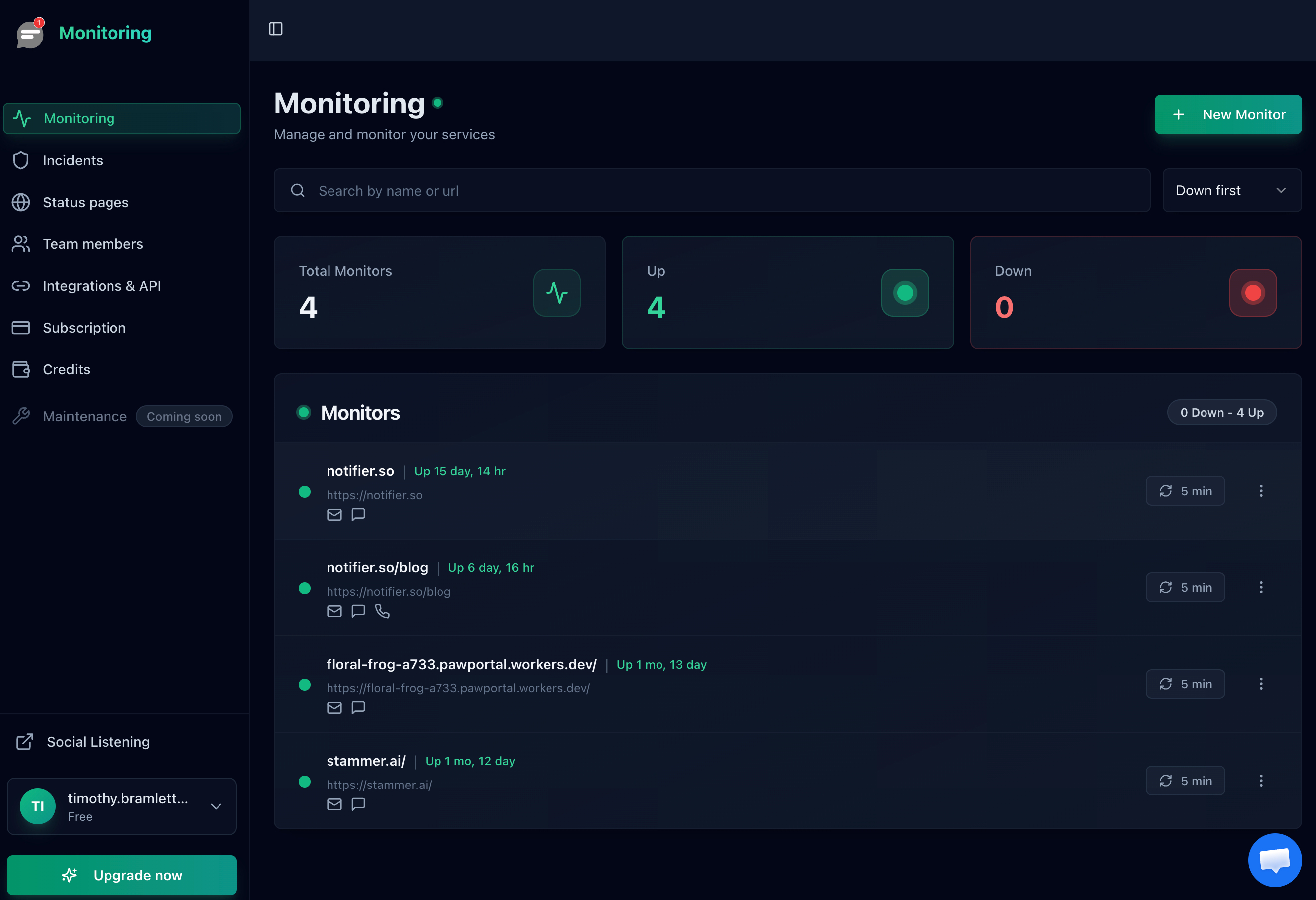
If you do not need Datadog's full observability suite or Pingdom's legacy brand, consider what you actually need. Most teams searching "Datadog vs Pingdom" want one thing: to know when their website goes down and to get alerted immediately. Notifier does exactly that, at a fraction of the cost of either tool.
| Feature | Datadog | Pingdom | Notifier |
|---|---|---|---|
| Free plan | Limited | None | 10 monitors, 5 status pages |
| 10 monitors cost | ~$216/mo | $10/mo | $0 (free) |
| 100 monitors cost | ~$2,160/mo | $95/mo | $19/mo |
| Fastest check interval | Configurable | 1 min | 30 sec |
| SMS alerts | Via PagerDuty | Credit-based | Unlimited (all paid) |
| Phone call alerts | Via PagerDuty | No | Unlimited (all paid) |
| Status pages | Via Incident Response | 1 per org | 5 free, up to unlimited |
| Billing surprises | Common | Rare | None (flat pricing) |
Notifier includes SMS and phone call alerts on all paid plans starting at $4/month, with no credit system and no per-message fees. Neither Datadog nor Pingdom offer native phone call alerts. Notifier's Team plan at $19/month gives you 100 monitors with 30 second checks, 50 status pages with custom domains, Slack integration, and 3 team members. The same monitoring scope on Pingdom costs $95/month with 1 minute checks and 1 status page. On Datadog, it costs over $2,000/month.
If you need infrastructure monitoring, APM, or log management, Datadog is the right tool. If you need RUM or transaction monitoring, Pingdom is worth considering. But if you need uptime monitoring with instant alerts and status pages, there is no reason to pay enterprise prices for it.
Frequently Asked Questions
Should I use Datadog just for uptime monitoring?
No. Datadog's synthetic monitoring pricing is designed as an add-on for teams already using Datadog for infrastructure or APM. Using it as a standalone uptime monitoring tool costs 10 to 100 times more than dedicated monitoring tools like Pingdom or Notifier. If you already pay for Datadog and want to consolidate, it makes sense. If you are starting from scratch, it does not.
Is Pingdom's future secure under private equity?
It is uncertain. SolarWinds (Pingdom's parent company) was acquired by Turn/River Capital in April 2025 and taken private. Private equity acquisitions of software companies often prioritize cost optimization over product development. Pingdom has not seen significant feature innovation in recent years. It still works well for what it does, but long-term investment in the product is not guaranteed.
How do I avoid Datadog bill shock?
Set up billing alerts and usage caps. Deploy the Datadog agent as a DaemonSet (not per-pod) in Kubernetes. Audit custom metrics regularly and avoid high-cardinality tags. Use log exclusion filters to prevent debug logs from inflating ingestion costs. Review your bill monthly against actual usage. Even with precautions, Datadog's usage-based model makes it harder to predict costs than flat-rate alternatives.
Does Pingdom have a free plan?
No. Pingdom offers a 14-day free trial but has no free tier. The cheapest plan starts at $10/month (annual) for 10 monitors. If you need free uptime monitoring, Notifier offers 10 monitors and 5 status pages on its free plan, with no trial period and no credit card required.
Can I use both tools together?
Yes, some teams use Datadog for infrastructure and APM while using a separate tool for uptime monitoring. This is actually common because Datadog's synthetic monitoring pricing is so high for simple uptime checks. You get the best of both worlds: Datadog's observability for deep debugging, and a dedicated monitoring tool for affordable, reliable uptime alerts and status pages.
Which tool has better RUM?
Both offer solid RUM products, but they are priced differently. Pingdom charges by pageviews (starting at $10/month for 100K pageviews). Datadog charges by session ($0.15 per 1K sessions on the basic tier). For high-traffic sites, compare the cost based on your actual traffic volume. If you do not need RUM and just need uptime monitoring, neither tool's RUM pricing is relevant to your decision.