Better Stack and UptimeRobot are two of the most popular uptime monitoring tools, but they solve different problems. UptimeRobot is a focused monitoring tool that checks if your sites are up and alerts you when they are not. Better Stack is an all-in-one platform that adds incident management, on-call scheduling, and observability on top of monitoring.
The question is not which tool is "better." It is which tool fits what you actually need. If you need on-call rotations and escalation policies, the answer is different than if you just want to know when your site goes down.
This comparison breaks down pricing, features, free tiers, status pages, and alert channels so you can make an informed choice.
Quick Verdict
Choose Better Stack if:
- + You have a team with on-call rotations
- + You need incident management and escalation policies
- + You want monitoring + incidents in one tool (instead of monitoring + PagerDuty)
- + You need logs and traces alongside monitoring
- − Budget is not your primary concern
Choose UptimeRobot if:
- + You just need uptime checks and alerts
- + You want a simple, focused tool with minimal setup
- + You need 50+ monitors on a budget
- + You are familiar with the platform (2.1M+ users since 2010)
- − You are not running a commercial project (free plan restrictions)
Pricing Comparison
This is where the two tools diverge the most. UptimeRobot uses traditional plan-based pricing. Better Stack uses component-based pricing where you pay per responder, per block of monitors, and per status page add-on.
UptimeRobot Plans
| Plan | Monthly | Annual | Monitors | Interval |
|---|---|---|---|---|
| Free | $0 | $0 | 50 | 5 min |
| Solo | $8 | $7 | 10 | 1 min |
| Team | $34 | $29 | 100 | 1 min |
| Enterprise | $64 | $54 | 200 | 30 sec |
Better Stack Components
| Component | Monthly | Annual |
|---|---|---|
| Paid responder | $34/responder | $29/responder |
| Additional 50 monitors | $25 | $21 |
| Additional status page | $15 | $12 |
| Password-protected status page | $50/page | $42/page |
| Advanced Slack/Teams | $9/responder | $9/responder |
What You Actually Pay at Each Scale
Better Stack's component pricing makes it hard to estimate costs. Here is what each tool costs at common monitor counts (annual billing):
| Monitors | Better Stack* | UptimeRobot |
|---|---|---|
| 10 | $0 (free tier) | $0 (free) or $7/mo (Solo) |
| 50 | ~$50/mo | $0 (free, non-commercial) or $29/mo (Team) |
| 100 | ~$71/mo | $29/mo (Team) |
| 200 | ~$113/mo | $54/mo (Enterprise) |
*Better Stack estimates assume 1 paid responder plus monitor add-on blocks. Adding more team members increases costs by $29/responder/month.
The pricing gap widens with teams
The comparison above uses 1 responder on Better Stack. If you have 3 on-call engineers, add $87/month (3 x $29) to every Better Stack estimate. A team with 100 monitors and 3 responders would pay approximately $158/month on Better Stack versus $29/month on UptimeRobot Team (which includes 3 login seats). That is a 5x difference.
Free Tier Comparison
| Feature | Better Stack Free | UptimeRobot Free |
|---|---|---|
| Monitors | 10 + 10 heartbeats | 50 |
| Check interval | 3 min | 5 min |
| Status pages | 1 (with custom subdomain) | 1 (branded) |
| Slack | Yes | No (Solo+ only) |
| SMS alerts | Via 1 free responder | One-time credits |
| Phone call alerts | Via 1 free responder | One-time credits |
| Webhooks | Yes | No (Team+ only) |
| Incident management | Basic | No |
| Incident history | 2 months | Unlimited |
| Commercial use | Yes | No (since Dec 2024) |
Better Stack's free tier wins on features: Slack integration, webhooks, incident management, and commercial use are all included. UptimeRobot's free tier wins on quantity: 50 monitors versus 10. But there is a significant caveat.
UptimeRobot's free plan is for personal use only. Since December 2024, commercial use of UptimeRobot's free plan is "strictly prohibited." If you run a business, accept payments, or generate revenue from your site, you are required to use a paid plan. This change was announced with less than a month's notice over Thanksgiving weekend in 2024, and the backlash was significant. If you are running a business, UptimeRobot's free plan is not an option.
Feature Comparison
Monitoring Capabilities
| Monitor Type | Better Stack | UptimeRobot |
|---|---|---|
| HTTP/HTTPS | Yes | Yes |
| Ping/ICMP | Yes | Yes |
| TCP/Port | Yes | Yes |
| Keyword | No | Yes |
| Heartbeat/Cron | Yes | Yes |
| SSL certificate | Yes (hourly) | Yes |
| Domain expiration | Yes | Yes |
| DNS record | Yes | Yes |
| Transaction monitoring | Yes (Playwright) | No |
| Email (POP3/IMAP/SMTP) | Yes | No |
Both tools cover the essentials. Better Stack adds Playwright-based transaction monitoring (useful for testing multi-step flows like login or checkout) and email server monitoring. UptimeRobot includes keyword monitoring (checking that a specific string appears on the page), which Better Stack does not support natively.
Incident Management (Better Stack Only)
This is Better Stack's main differentiator. The platform includes:
- On-call scheduling: Drag-and-drop calendar with workweek/weekend and follow-the-sun rotations. Syncs with Google Calendar and Outlook.
- Escalation policies: If the primary on-call engineer does not acknowledge within a set time, the alert escalates to the next person.
- Incident merging: When multiple monitors detect the same outage, Better Stack consolidates them into a single incident.
- Incident timeline: Second-by-second record with error screenshots and traceroute data.
- Postmortem reports: Built-in tools for writing incident reports after resolution.
UptimeRobot has no incident management features. If you need on-call scheduling or escalation policies with UptimeRobot, you would add a separate tool like PagerDuty (starting at $21/user/month) or Opsgenie.
Do you actually need incident management?
If you are a solo developer, a small team, or a freelancer managing client sites, you probably do not. Slack or SMS alerts go to the person who can fix it. There is no rotation because there is one person. Incident management becomes valuable when you have 5+ engineers, rotating on-call schedules, and need formal escalation so alerts do not get missed.
Status Page Comparison
| Feature | Better Stack | UptimeRobot |
|---|---|---|
| Free pages | 1 | 1 (branded) |
| Custom domain | Yes (even on free) | Paid plans only |
| Branding removal | Paid plans | Paid plans |
| Password protection | $42 to $50/page | Team+ ($29/mo) |
| Additional pages | $12 to $15 each | 3 (Solo), 100 (Team), Unlimited (Enterprise) |
| Email subscriptions | Yes | Yes |
| Design quality | Clean, modern | Basic, dated |
Better Stack's free status page supports custom subdomains (status.yourdomain.com), which is a meaningful advantage. The design is more modern than UptimeRobot's. However, adding more status pages gets expensive quickly at $12 to $15 per page, and password protection costs $42 to $50 per page.
UptimeRobot includes more status pages on its paid plans (100 on Team, unlimited on Enterprise) at a lower total cost, but the pages look more basic. Custom domains require a paid plan.
Alert Channel Comparison
How you get notified about downtime matters as much as detecting it. Here is what each tool offers and what it costs:
| Channel | Better Stack | UptimeRobot |
|---|---|---|
| All plans | All plans | |
| SMS | Unlimited (paid responders) | One-time credits (not monthly) |
| Phone calls | Unlimited (all responders) | One-time credits (not monthly) |
| Slack | Free plan | Solo+ ($7/mo) |
| Microsoft Teams | Paid plans | Solo+ ($7/mo) |
| Webhooks | Free plan | Team+ ($29/mo) |
| PagerDuty | Paid plans | Team+ ($29/mo) |
| Discord | No | All plans |
Better Stack wins on SMS and phone call alerts. Paid responders get unlimited SMS and phone calls with no credit system and no per-message fees.
UptimeRobot's SMS/voice system uses one-time credits, not a monthly allowance. When your welcome credits run out, you buy more at $3 for 10 credits. This is a common point of confusion: users assume they get fresh credits each month, but they do not.
UptimeRobot also locks several integrations behind higher tiers. Slack requires the Solo plan ($7/month). Webhooks, Zapier, and PagerDuty require the Team plan ($29/month). If you need webhook-based integrations on a budget, Better Stack's free plan is more generous.
Consider Also: Notifier
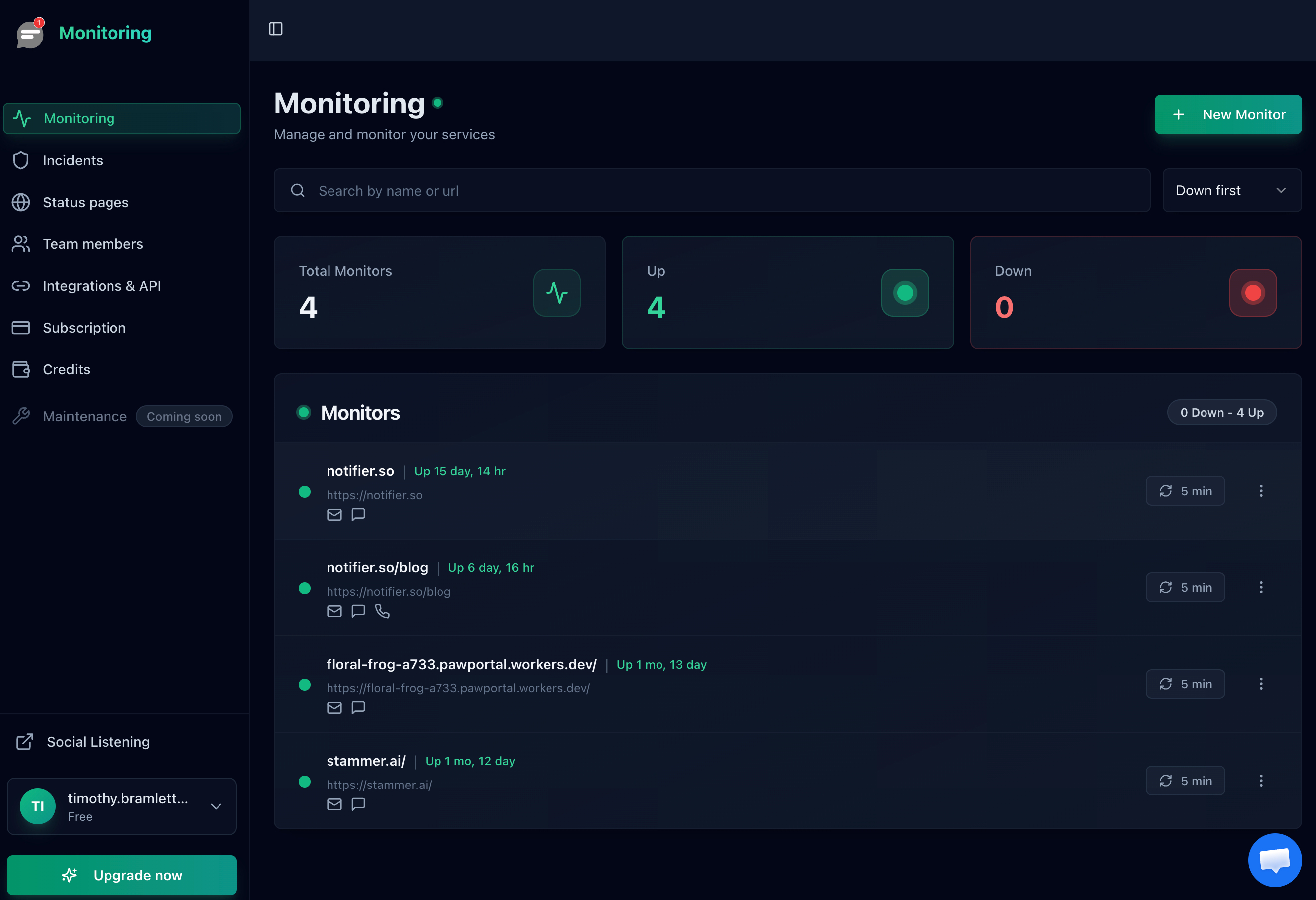
If neither Better Stack nor UptimeRobot feels right, there is a third option worth considering. Notifier sits between the two: simpler and more affordable than Better Stack, with more included features than UptimeRobot at every price point.
| Feature | Better Stack | UptimeRobot | Notifier |
|---|---|---|---|
| Free monitors | 10 | 50 (non-commercial) | 10 (commercial OK) |
| Cheapest paid plan | $29/mo (responder) | $7/mo (Solo) | $4/mo (Solo) |
| 100 monitors | ~$71/mo | $29/mo | $19/mo |
| 30 sec checks | Paid plans | $54/mo (Enterprise) | $19/mo (Team) |
| SMS/Phone | Unlimited (paid) | One-time credits | Unlimited (all paid) |
| Status pages (free) | 1 | 1 | 5 |
| Custom domain pages | Free (subdomain) | Paid plans | All paid ($4+) |
| Slack | Free | $7/mo (Solo+) | All paid plans |
| Incident management | Yes | No | No |
| Pricing model | Per-component | Per-plan | Per-plan |
Notifier does not have incident management or on-call scheduling. If you need those, Better Stack is the right choice. But for teams that just want reliable monitoring, alerts across multiple channels, and status pages with custom domains, Notifier delivers all of that at the lowest price in the market. The Team plan at $19/month includes 100 monitors with 30 second checks, 50 status pages, Slack integration, and unlimited SMS/phone alerts with 3 team members. That same configuration on Better Stack would cost over $70/month, and on UptimeRobot it would require the $29/month Team plan without 30 second checks or unlimited SMS.
Support is another differentiator. Notifier is built by a small team that responds within minutes via chat or email. You are talking to the people who build the product, not a tiered support organization.
Frequently Asked Questions
Is Better Stack worth the higher price?
If you need incident management, on-call scheduling, and escalation policies, yes. Better Stack consolidates monitoring, incidents, and on-call into one tool. A team paying separately for UptimeRobot + PagerDuty + Statuspage could spend more than Better Stack alone. But if you just need uptime monitoring and alerts, Better Stack's per-responder pricing makes it expensive for what you actually use.
Can I use UptimeRobot's free plan for my business?
No. Since December 2024, UptimeRobot's free plan is restricted to non-commercial use. Businesses, revenue-generating sites, and commercial projects must use a paid plan. Open-source projects, educational institutions, and nonprofits are exempt. If you need a free plan for commercial use, Better Stack and Notifier both allow it.
Why does UptimeRobot Solo have fewer monitors than the free plan?
UptimeRobot's Solo plan includes only 10 monitors, down from 50 on the free plan. The trade-off is 1 minute checks instead of 5, plus access to Slack and other integrations. To get back to 100 monitors, you need the Team plan at $29/month. This pricing structure is a common source of frustration for users upgrading from free.
How does Better Stack's per-responder pricing work?
A "responder" is a team member who receives alerts and participates in on-call rotations. Each paid responder costs $29/month (annual). You start with 10 free monitors, and each additional block of 50 monitors costs $21/month. Status pages beyond the first cost $12 to $15 each. The total bill depends on how many team members, monitors, and status pages you need.
Which tool has better status pages?
Better Stack's status pages are more modern in design and support custom subdomains even on the free plan. UptimeRobot includes more pages on its paid plans (up to unlimited on Enterprise) but the design is more basic. If status page quality is your priority and you want a free option, Better Stack's free tier is the stronger choice. If you want many status pages at a low price, UptimeRobot Team or Notifier (50 pages on the $19/month plan) offer better value.
Can I migrate from one to the other?
Yes, but there is no automated migration tool between them. You will need to recreate your monitors manually. Both tools have APIs, so if you have many monitors, you could script the migration. Budget 30 minutes to an hour for a manual switch with under 50 monitors.