Here is how most startup founders find out their app is down: a customer emails them. Or worse, a prospect tries the product during a demo and gets an error page.
Groove, a help desk startup, learned this the hard way. Their hosting provider accidentally terminated their database server overnight. The founder found out 11 hours later when a team member called him at 7:30 AM. Customers on the other side of the world had gone an entire business day without the product, with zero communication from Groove about what was happening.
The fix was not complicated. They set up monitoring with phone call alerts and a public status page. Total monthly cost: less than a team lunch. The lesson was expensive, though. They lost trust they had to spend months rebuilding.
This guide ranks the 7 best uptime monitoring tools for startups in 2026, with a focus on free tiers, affordable upgrade paths, and what you actually need at each stage of growth.
Why Startups Cannot Skip Monitoring
When you are pre-revenue with 10 users, it is tempting to think monitoring is something you will add later. But "later" usually means "after something goes wrong." Here is why startups need monitoring from day one:
Every User Matters More
Enterprise companies can absorb some churn from downtime incidents. Startups cannot. When you have 50 users and 3 of them hit an outage during their first week, that is 6% of your user base having a bad first impression. One in three customers will leave a brand they love after a single bad experience. For a startup still building trust, those odds are devastating.
You Are the On-Call Team
At most startups, there is no DevOps team. The founder is the on-call engineer, the support agent, and the incident commander. If your monitoring sends email-only alerts and your app goes down at 2 AM, you will not find out until morning. By then, users in other time zones have had an entire day without your product.
Status Pages Build Credibility
Enterprise buyers check your status page before signing a contract. Investors ask about reliability during due diligence. Even early adopters feel better about a product that has a status page at status.yourapp.com. It signals that you take reliability seriously, even if you are a two-person team. A startup without a status page looks like a startup that does not track its own uptime.
The real cost for small businesses
Small businesses lose an average of $2,500 per month from approximately 5 hours of unplanned downtime. For a startup doing $5K MRR, that is half your revenue gone. And the reputational damage compounds: 60% of consumers say they are unlikely to return to a site after a bad experience.
What You Need at Each Growth Stage
Your monitoring needs change as your startup grows. Here is what matters at each stage and what you can skip:
Pre-Launch / MVP
You have a landing page and maybe an app in development. You need 1 to 3 monitors: your landing page URL, your app URL (if live), and maybe a domain expiration check. Email alerts are sufficient at this stage. A free plan on any monitoring tool will cover this.
Recommended spend: $0/month
Post-Launch, First Users (1 to 50 users)
You have real users depending on your product. This is when the "I found out from a customer" problem becomes real. You need SMS or phone call alerts, because email alone will not wake you up at 3 AM. You need a status page so users can check status themselves instead of emailing you. You need 3 to 10 monitors covering your app, API, and key pages.
Recommended spend: $0 to $4/month
Growing (100+ users, paying customers)
Downtime now directly costs revenue. You need 1 minute check intervals (5 minutes is too slow when customers are paying). You need a professional status page with a custom domain. Slack integration keeps the team aware. Multi-region checks catch CDN and DNS issues that affect specific geographies.
Recommended spend: $4 to $19/month
Scaling (team of 5+, multiple services)
You have multiple microservices, a growing team, and possibly investors who care about reliability metrics. You need 50 to 100+ monitors, 30 second check intervals, team access for multiple engineers, and status pages per product or service. If your team is large enough, you might need on-call rotation features.
Recommended spend: $19 to $35/month
The 7 Best Uptime Monitoring Tools for Startups
1. Notifier
Best overall for startups. Best free-to-paid upgrade path.
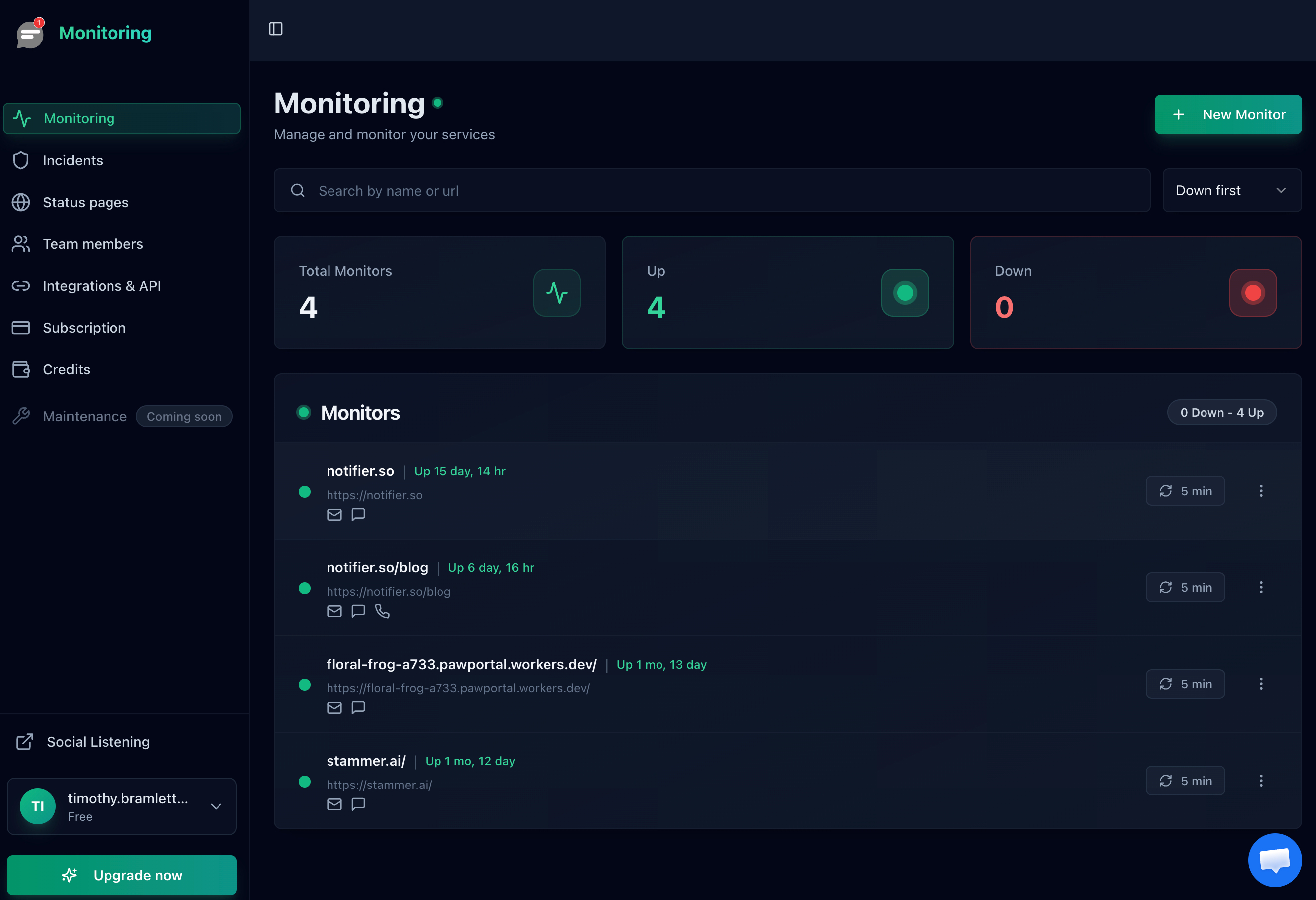
Notifier is built for the startup use case. The free plan includes 10 monitors, 5 status pages, and SMS and phone call alerts with no per-message fees. Commercial use is allowed on all plans, including free. When you are ready to upgrade, the Solo plan at $4/month gives you 20 monitors with 1 minute checks and custom domain status pages.
The upgrade path scales cleanly: $4/month for early-stage, $19/month for a growing team (100 monitors, 30 second checks, 3 team members), and $35/month for scaling (200 monitors, unlimited status pages, 10 team members). No surprise costs, no per-component pricing, no SMS credit systems.
If you run into issues, the support team responds within minutes. Unlike larger competitors where you submit a ticket and wait days, you are dealing with a small team that actually uses the product they build.
Best for: Any startup from pre-launch to scaling. The free tier is generous enough to start, and the paid plans grow with you without pricing surprises.
2. UptimeRobot
Most monitors on a free plan, but only for non-commercial use.
UptimeRobot is one of the most recognized names in monitoring, with over 2 million users. The free plan offers 50 monitors with 5 minute checks, which is the highest free monitor count available.
The catch: Since December 2024, the free plan is restricted to non-commercial use only. If your startup generates revenue, accepts payments, or operates as a business, you are required to use a paid plan. Open-source projects, educational use, and nonprofits are exempt.
The paid plans have an awkward progression. The Solo plan at $7/month drops to only 10 monitors (down from 50 on free), gains 1 minute checks and 3 basic status pages. To get 100 monitors, you need the Team plan at $29/month. SMS uses a one-time credit bundle, not a monthly allowance. Advanced integrations like webhooks and PagerDuty are locked to Team and above.
Best for: Open-source projects, side projects, and pre-commercial startups that want the most monitors possible for free. Once you are a business, the paid plans are less competitive.
3. Better Stack
Best if you need incident management and on-call built in.
Better Stack combines uptime monitoring with incident management, on-call scheduling, and status pages. The free tier includes 10 monitors with 3 minute checks, 10 heartbeats, 1 status page, and email/Slack alerts.
The value proposition is clear: if your startup has grown to the point where you need on-call rotations and escalation policies, Better Stack gives you monitoring and incident management in one tool instead of paying for both separately.
The trade-off: Component-based pricing makes costs hard to predict. Paid plans start at $29/responder/month plus $21 per additional 50 monitors. A small team with 50 monitors and 2 on-call engineers would pay approximately $79/month. For most early-stage startups, this is more than they need or can afford.
Best for: Startups at the scaling stage (team of 5+) that need incident management workflows. Not a good fit for early-stage startups on a budget.
4. Pulsetic
Best status page design out of the box.
Pulsetic differentiates with beautiful, well-designed status pages that look polished without custom development. If the appearance of your status page matters to your brand (and for customer-facing startups, it should), Pulsetic is worth considering.
The free plan includes 10 monitors with 5 minute checks and 3 status pages. The Solo plan at $9/month adds 1 minute checks, Slack integration, and 30+ SMS alerts. The Team plan at $19/month gives you 50 monitors with 30 second checks and password-protected status pages.
Watch the add-ons: extra monitors cost $0.20/month each, team members are $8/month each, and SMS beyond your plan allocation is $0.10 per alert. At 100 monitors on the Team plan, you would pay $19 plus $10 for the extra 50 monitors, plus $8 per additional team member.
Best for: Design-conscious startups that want a polished status page experience and do not mind paying slightly more for it.
5. StatusCake
Best for bundled SSL, domain, and page speed monitoring.
StatusCake packs uptime monitoring with SSL certificate monitoring, page speed monitoring, and domain expiration checks. If you want several monitoring types in one dashboard, it covers more ground than most competitors.
The free plan includes 10 monitors at 5 minute intervals, but no SMS credits and no status pages. Status pages are sold as a separate product. The Superior plan at $20.41/month (annual) gives you 100 monitors with 1 minute checks, SSL and domain monitoring, and 75 SMS credits per month.
Best for: Startups that want SSL and domain monitoring bundled with uptime monitoring. Less ideal if you need status pages included in your plan.
6. HetrixTools
Best free plan for technical founders who want 1 minute checks.
HetrixTools offers 15 free monitors with 1 minute check intervals, unlimited status pages, and 18+ notification integrations including Slack, Discord, and PagerDuty. The 1 minute checks on the free plan are unusual; most competitors offer 3 to 5 minute intervals at the free tier.
The paid Professional plan at $9.95/month doubles your monitors to 30 and adds 25 SMS credits, maintenance mode, and API access. HetrixTools also includes blacklist monitoring and server monitoring, which are uncommon at this price point.
The catch: The free plan has a 90-day login requirement. If you do not log in every 90 days, your account is deactivated. SMS on the free plan requires purchasing credits at $0.20 each. The interface looks dated compared to newer tools.
Best for: Technical founders who want fast checks on a free plan and do not mind a less polished UI.
7. Uptime Kuma
Best self-hosted option. Free forever, if you maintain it yourself.
Uptime Kuma is a free, open-source monitoring tool with over 83,000 GitHub stars. It supports unlimited monitors, 20 second check intervals, unlimited status pages, and 90+ notification integrations. You deploy it on your own server:
docker run -d --restart=always -p 3001:3001 -v uptime-kuma:/app/data --name uptime-kuma louislam/uptime-kuma:2The fundamental problem for startups is reliability. If you host Uptime Kuma on the same cloud provider as your app and that provider has an outage, your monitoring goes down with your app. You will not get alerted about the outage you need to know about. Performance also degrades beyond 150 to 500 monitors, multi-user support is still in early stages, and you are responsible for all updates and security patches.
Best for: Technical founders who have a separate server on a different provider specifically for monitoring, enjoy self-hosting, and want zero recurring costs. Not recommended for non-technical founders or teams that cannot afford single-point-of-failure risk.
Side-by-Side Comparison
This table focuses on what matters most for startups: free tier generosity, the cost of the first paid upgrade, and whether commercial use is allowed:
| Tool | Free Monitors | Free Interval | Free Status Pages | Commercial Use | First Paid Plan |
|---|---|---|---|---|---|
| Notifier | 10 | 5 min | 5 | Yes | $4/mo (20 monitors, 1 min) |
| UptimeRobot | 50 | 5 min | 1 | No | $7/mo (10 monitors, 1 min) |
| Better Stack | 10 | 3 min | 1 | Yes | ~$50/mo (50 monitors + responder) |
| Pulsetic | 10 | 5 min | 3 | Yes | $9/mo (10 monitors, 1 min) |
| StatusCake | 10 | 5 min | 0 | Yes | $20/mo (100 monitors, 1 min) |
| HetrixTools | 15 | 1 min | Unlimited | Yes | $10/mo (30 monitors, 1 min) |
| Uptime Kuma | Unlimited | 20 sec | Unlimited | Yes | Free (self-hosted) |
Free Tier Gotchas That Bite Startups
Not all free plans are created equal. Here are the hidden restrictions that catch founders off guard:
UptimeRobot: Commercial Use Banned
This is the biggest gotcha in the monitoring space. Since December 2024, UptimeRobot's free plan is "strictly for non-commercial purposes." If your startup generates revenue, accepts payments, or operates as a business, you are violating their terms of service on the free plan. Unauthorized commercial use "may result in suspension or termination." Most comparison articles still recommend UptimeRobot's free tier for businesses without mentioning this restriction.
UptimeRobot: Solo Plan Drops to 10 Monitors
If you upgrade from UptimeRobot's free plan to the Solo plan at $7/month, your monitor count drops from 50 to 10. To get back to 50+ monitors, you need the Team plan at $29/month. This pricing structure punishes startups that outgrow the free tier.
Better Stack: Component Pricing Surprise
Better Stack's free tier looks generous (10 monitors, 1 status page), but the jump to paid is steep. You pay per responder ($29/month each), per block of 50 monitors ($21/month), and per additional status page ($12 to $15 each). A startup with 50 monitors and 2 team members quickly hits $79/month, which is out of reach for most early-stage companies.
HetrixTools: 90-Day Login Requirement
HetrixTools deactivates free accounts that have not logged in within 90 days. A founder on parental leave, a long vacation, or simply focused on other parts of the business could lose all monitoring without warning.
StatusCake and Pulsetic: Missing Alert Channels on Free
StatusCake's free plan has no SMS credits and no status pages. Pulsetic's free plan has no SMS, no Slack, and no webhooks. You get email alerts only, which is the monitoring equivalent of hoping you will check your inbox at 3 AM.
Why this matters
Startups pick a monitoring tool once and then forget about it. You set up your monitors, configure your alerts, and move on to building product. If your free plan has hidden restrictions that surface six months later (account deactivation, commercial use violation, missing alerts), you find out at the worst possible time: during an outage.
When to Upgrade from Free to Paid
Free monitoring is fine when you are starting out. But at some point, the free tier becomes a liability. Here are the signals that it is time to upgrade:
| Signal | What It Means |
|---|---|
| You have paying customers | Revenue is tied to uptime. Five minutes of undetected downtime now has a dollar cost. |
| You need more than 10 monitors | You have an app, an API, a marketing site, docs, and maybe a staging environment. Free tiers run out. |
| Five-minute checks feel too slow | Users are noticing downtime before you do. One-minute or 30-second checks close the gap. |
| You need a custom domain status page | Enterprise prospects or investors are asking about reliability. status.yourapp.com looks professional. |
| Multiple people need dashboard access | You hired your first engineer. They need to see monitoring data without sharing a single login. |
| You need Slack integration | Your team communicates in Slack. Downtime alerts should go where the team already is. |
If two or more of these apply to you, it is time to upgrade. At $4/month for a plan like Notifier's Solo, the cost is less than a coffee. The cost of not upgrading is finding out about your next outage from a customer email.
Freshping Is Shutting Down: Where to Migrate
If you are a startup using Freshping, you need to act quickly. Freshworks announced that Freshping shuts down on March 6, 2026. All monitoring data will be permanently deleted approximately 90 days later.
Freshping was popular with startups because of its generous free tier: 50 monitors, 1 minute checks, 5 status pages, and 10 global locations. Finding a replacement that matches those specs for free is difficult, because no other tool offers that exact combination.
Here is how the best alternatives compare to what Freshping offered:
| Feature | Freshping (gone) | Notifier (Free) | Notifier (Solo $4/mo) |
|---|---|---|---|
| Monitors | 50 | 10 | 20 |
| Check interval | 1 min | 5 min | 1 min |
| Status pages | 5 | 5 | 10 (custom domain) |
| SMS/Phone alerts | Via Twilio | Included | Included |
| Commercial use | Yes | Yes | Yes |
For the full migration guide with step-by-step instructions, see our Freshping shutdown and migration guide.
Frequently Asked Questions
Do I really need monitoring before I have users?
Yes, but minimal monitoring is fine. Set up a single monitor on your landing page or app URL. It takes 30 seconds, it is free, and it catches problems like expired SSL certificates or DNS misconfigurations that scare away early visitors. The worst time to discover your site is down is when a potential investor or early adopter tries to check it out.
Is email-only alerting enough for a startup?
Not once you have real users. Email is unreliable for urgent notifications. It can land in spam, you might not check it for hours, and it will not wake you up at night. If users depend on your product, you need at least SMS alerts. Phone call alerts are even better for critical outages. This is exactly why Groove's 11-hour outage went undetected: they had email-only alerts.
Should I use free monitoring or pay from the start?
Start free if you have fewer than 10 things to monitor, no paying customers, and email alerts are acceptable for now. Upgrade when you have paying customers, need faster checks, or want SMS/phone alerts and a professional status page. The cheapest paid plans start at $4/month. If your startup has any revenue at all, that is an easy expense to justify.
How many monitors does a typical startup need?
Pre-launch: 1 to 3 (landing page, app, maybe API). Post-launch: 5 to 10 (app, API, marketing site, key pages, health endpoints). Growing: 10 to 50 (add staging environments, individual API endpoints, webhook receivers). Scaling: 50 to 200 (multiple services, databases, background workers, per-region checks). Most startups stay under 20 monitors for their first year.
Can I use UptimeRobot free for my startup?
Only if your startup is non-commercial. Since December 2024, UptimeRobot's free plan restricts commercial use. If you accept payments, sell a product, or operate as a business, you need a paid plan. For a free plan that allows commercial use with SMS alerts and status pages included, try Notifier.
Do investors care about uptime monitoring?
Not directly, but they care about what monitoring signals. A public status page shows operational maturity. Uptime history shows you track your reliability. Incident reports show you handle problems transparently. During due diligence for Series A and beyond, investors (and their technical advisors) do check this. Having monitoring set up from day one is the kind of detail that separates serious founders from hobbyists.